The Problem You Think You Have
Every voltage tester sourcing conversation starts the same way. Someone needs a non contact voltage tester, or a batch of voltage tester pens, and the first question is always about price.
I get it. I did the same thing in 2017, my first year handling electrical equipment orders. I compared quotes. I negotiated. I felt good about saving 8% on a supplier switch.
Then I learned that price was the least important variable in this entire category. That lesson cost me $3,400.
The Real Problem Nobody Warns You About
Here's the thing about voltage tester sourcing: the product name tells you almost nothing about what you're actually buying.
"Non-contact voltage tester" isn't a specification. It's a category. Two products with that exact label can have completely different voltage ranges, different safety ratings, and vastly different reliability. One might work perfectly for years. The other might fail the first time someone uses it on a 480V panel.
I've made (and documented) enough mistakes in this category to fill a small notebook. Most of them trace back to one root cause: treating a safety instrument like a commodity purchase.
Layer 1: The Voltage Range Trap
Most buyers check the voltage range. Good. But here's what they miss: the tested range and the rated range aren't always the same thing.
A DC voltage tester might say "12V-1000V" on the box. But what does that mean? Is it accurate at the low end? Does it hold up at the high end? Does sensitivity degrade in a noisy electrical environment?
The answer depends on internal circuitry. And you can't see that from a product listing.
Layer 2: The CAT Rating Most Buyers Skip
This one drives me crazy. CAT ratings exist for a reason.
CAT II covers single-phase receptacle circuits. CAT III covers three-phase distribution. CAT IV covers origin-of-installation equipment. The classification reflects the transient overvoltage environment — how much energy could flow through the tester if something goes wrong.
Using a CAT II-rated non contact voltage tester near a CAT III panel isn't just "less ideal." It's a safety gap. The tester might work fine 99 times out of 100. That 100th time is the problem.
I once asked a supplier what CAT rating their electric voltage tester was designed for. They said "it works on all voltages." That's not a CAT rating. That's a red flag. I should have walked away right there. Instead, I filed it under "probably fine" and moved on. Wrong call.
Layer 3: The "Pen" Problem
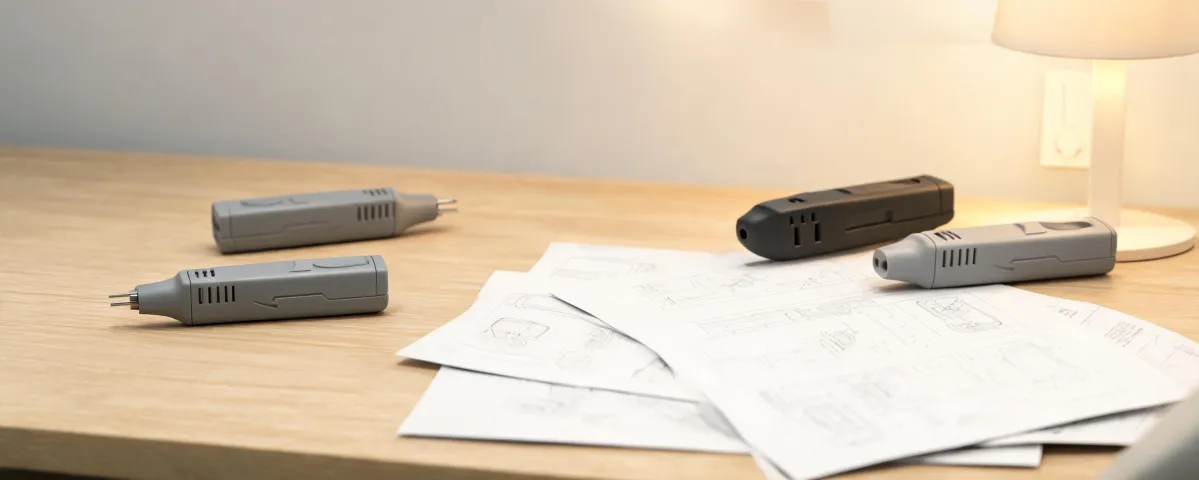
Non contact voltage tester pens are the worst offenders in this category. They're cheap to manufacture, cheap to ship, and easy to list on any sourcing platform. The capacitor-coupled sensing method they use is simple enough that almost anyone can build one.
That's the problem. Almost anyone does.
I've tested pens from six different suppliers over the years. Two were reasonably accurate. Two worked but had annoying latency issues — seriously, a 2-second delay in a tester is a safety issue. Two would trigger on any nearby conductor, including a phone charger cable. Not ideal. Not safe either.
Here's a detail most buyers never check: whether the pen indicates the actual voltage level or just the presence of voltage. "Non-contact" can mean "beeps when there's voltage nearby" or "displays the approximate voltage reading." Those are very different products. And suppliers rarely volunteer which one they're selling.
What This Costs You
In March 2022, I placed an order for 600 non-contact voltage tester pens. The unit price was excellent — about $4.80 each, roughly 15% below our previous supplier.
I knew I should verify the CAT rating and check IEC compliance documentation. But the supplier had good reviews, the samples looked fine, and I thought "what are the odds this batch is bad?" The odds caught up with me.
The shipment arrived in late April. We sent the first 50 units to a contractor client who planned to use them for residential service calls. Fifteen units came back within two weeks. The issue was consistent: false negatives. The pen stayed silent on live circuits.
For a residential service call, a false negative on a non-contact voltage tester means someone might grab a wire they believe is dead. This is the kind of failure that doesn't just cost money. It costs trust, and potentially much more.
We recalled the entire batch. Out of 600 units, about 22% failed our basic verification test. Re-shipping and replacing cost us $2,800. The original order was $3,400, and we ended up spending nearly that much again to make it right.
But the bigger loss was the client relationship. That contractor placed three more orders with us that year. After the recall, he took his business elsewhere. I'd estimate we lost about $12,000 in future revenue from that one relationship.
All because I saved $700 on the unit price.
The Checklist I Wish I'd Had
After that experience, I built a pre-purchase verification process for all voltage tester sourcing. It's not complicated. It just forces you to ask questions that suppliers don't volunteer answers to.
1. Get the CAT rating in writing. Not "works on all voltages." Not "high voltage safe." The actual CAT classification (II, III, or IV) and the voltage range it's rated for.
2. Ask for the standard reference. IEC 61010-1 and IEC 61010-2-030 apply to measurement equipment. If the supplier can't name a standard their product is designed to, that's your first warning sign.
3. Test for false negatives, not just false positives. Most sample testing checks whether the tester detects live voltage. The dangerous failure mode is when it doesn't. Run a dead-wire test alongside a live-wire test.
4. Verify the sensing principle. Is it capacitive coupling? Is it voltage detection with a display? Does it give a rough reading or just a beep? Match the sensing method to the actual use case.
5. Check the low-end accuracy. A DC voltage tester that works fine at 480V might struggle at 12V or 24V. If your application involves low-voltage circuits, test at those levels specifically.
6. Document everything. Every conversation, every spec sheet, every sample result. When you're sourcing from overseas, a verbal confirmation means nothing after the money changes hands.
My experience is based on about 200 voltage tester orders over the past seven years, mostly for North American and European clients. If you're sourcing for a different market or a very different application, your experience might differ. But I'd still bet my next order that the CAT rating question will save you from a mistake.
Look, voltage testers aren't like other products you source. They're safety instruments. A $2 difference in unit price doesn't mean you saved $2. It means you might be buying a different class of product entirely.
The cheaper option rarely stays cheaper once you factor in returns, replacements, and lost clients. Take it from someone who's learned that lesson with his own money.
